Article 5: Stroke fatigue, Why it happens and how to fight back
Estimated reading time: 8 minutes
Article Summary
This article addresses one of the most debilitating and misunderstood consequences of stroke fatigue and reframes it from a perceived weakness into what it truly is.
A neurological consequence of the brain working harder to rewire and recover.
It reinforces a core principle of the Rewired Runner approach.
Fatigue is not something you wait to disappear it is something you learn to manage, train, and gradually outgrow.
About the Author
Mark Ford is a stroke survivor who turned ultramarathon runner and is the founder of Rewired Runner. He helps survivors rebuild belief, energy, and purpose through movement.
Important Safety Note
This article shares lived experience supported by research, but it is not medical advice. Stroke recovery and mental health responses vary widely. If you’re experiencing persistent low mood, panic, trauma symptoms, or thoughts of self-harm, please reach out to a qualified clinician or crisis support in your country.
Introduction
Stroke fatigue is not ordinary tiredness. It is a neurological shutdown. It can leave you exhausted after doing almost nothing. It can drain your thinking, slow your speech, and make even basic tasks feel impossible. You can look fine to others while feeling broken inside. Fatigue is one of the most common and persistent effects of stroke, yet also one of the most misunderstood.
I lived with stroke fatigue for years. In the early months, I could barely function beyond a few hours a day. Even after I left the hospital, I would shower, get dressed, and need to sleep again. Cognitive tasks like writing emails, reading a page of text, or trying to hold conversations could flatten me. I would go from feeling “okay” to burned out in minutes. If this is your experience too, I understand. You are not alone, and there is a way forward.
Section 1: What is stroke fatigue and why does it happen?
Stroke fatigue happens because the brain is forced to work harder than before. When a stroke damages pathways in the brain, it must reroute signals and rebuild function. That rewiring process is called neuroplasticity, and it takes a huge amount of energy.
Even before a stroke, the brain uses around 20% of the body’s energy. After a stroke, one needs even more just to execute everyday tasks like walking, swallowing, concentrating, and speaking. Once automatic things now demand full attention. That energy cost leads to neurological overload and fatigue.
Fatigue is not just physical. It is cognitive and emotional. Overstimulation, stress, noise, screen time, anxiety, or emotional conversations can drain energy just as fast as physical effort.
What makes fatigue worse:
- Cognitive effort (thinking hard)
- Overstimulation (busy environments, noise, screens)
- Stress and emotional conflict
- Lack of quality sleep
- Post-stroke inflammation
- Medication effects
- High heart rate or blood pressure spikes
- Fatigue is not a character flaw, it’s neurology.
Section 2: The brain science behind stroke fatigue
Early in recovery, someone described my brain as being like a toddler again. At first, I didn’t like that analogy. But I later realised it was true. I had to re-learn simple things. How to coordinate my arms when walking. How to write again. How to speak clearly. These tasks took enormous mental effort.
I noticed a pattern: effort to exhaustion to adaptation.
That wasn’t failure, that was rewiring.
Scientifically, that makes sense. Neuroplasticity requires energy. New neural pathways are fragile at first. Repetition stabilises them. But repetition burns energy, which is why fatigue often increases temporarily during recovery, especially when you are progressing.
I also experienced “morning fatigue”. I thought sleep would recharge me, but I often woke up already exhausted. Later, I learned the brain continues rewiring overnight. A psychologist explained: “Your brain isn’t resting while you sleep, it’s rewiring, which uses energy. That’s why you wake up tired.”
A late-evening banana helped slightly, fuel for overnight repair. Small adjustments like that made a difference.
Stress made fatigue worse. Emotional rumination, like “why me?” or worrying about the future, overloaded my brain. I had to learn to protect my mental energy by accepting reality and focusing only on what I could control.
Section 3: How I worked my way out of fatigue
Stroke fatigue does not improve by simply resting more. Rest alone keeps you stuck. Fatigue improves when you train the brain to handle more load safely through gradual exposure and adaptation.
Here is what worked for me:
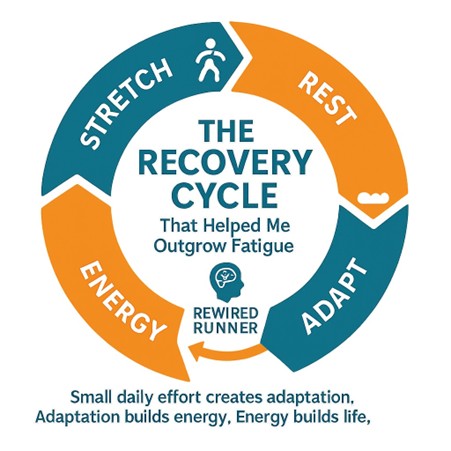
- The Recovery Cycle That Helped Me Outgrow Fatigue
- I developed a simple cycle based on how my brain responded to effort:
- Stretch → Rest → Adapt → Repeat
- Stretch: Do just slightly more than my current capacity.
- Rest: Recover before crashing.
- Adapt: Let the brain consolidate learning.
- Repeat: Do it again tomorrow.
This cycle mirrors how neuroplasticity works. Over months and years, I used it to gradually expand my energy capacity. I didn’t go from zero to ultramarathons. I started by walking to the letterbox. Then the neighbour’s fence. Then 200 metres. Then one kilometer. I adapted slowly.
This cycle stopped the boom-and-bust pattern many survivors fall into, doing too much on a “good day,” crashing for three days, then losing confidence. I stayed consistent by stretching just enough to grow without collapsing.
Practical Strategies That Help Reduce Fatigue:
- Movement before mindset
- Light movement increases blood flow and switches the brain on. A slow walk often helped me think more clearly.
- Present-moment focus
- Emotional fatigue is real. Worry drains cognitive energy. I used a grounding phrase:
- “It is what it is. It will be what it will be. I am here now.”
Active rest:
- I slept daily in the first year. Later, I replaced sleep with Yoga Nidra, a non-sleep, deep rest technique shown to help neurological recovery.
- One hard thing at a time
- Multitasking is energy sabotage. I stopped doing it. One task. Complete it. Move on.
The RR Fatigue Ladder:
- A system that made loading safe and repeatable:
- Red day: exhausted → gentle mobility + deep rest
- Amber day: manageable → light walking + low focus tasks
- Green day: good clarity → train + highest priorities
- Build capacity gradually
- You don’t wait for energy, you build it through consistency. Energy is earned.
Section 4: The recovery cycle: That helped me outgrow fatigue
Section 5: Closing
Stroke fatigue is one of the toughest battles a survivor faces. It steals confidence. It makes progress slow. It causes self-doubt. But fatigue is not permanent. You can outgrow it. You can rebuild endurance. And you can regain control of your days.
- The key isn’t motivation.
- Its structure.
- Its consistency.
- It’s small wins; repeated.
Your comeback doesn’t begin when fatigue disappears. It begins while you’re tired, the moment you decide to move anyway.
Forward is forward, no matter how small the step.
Support Us:
If you found value here, consider clicking the (Support Us button on the website), which is linked to “Buy Me a Coffee”, to make a small donation. This donation will help us to continue creating practical recovery resources.
References: (simplified, policy-aligned)
Cramer SC et al. Harnessing neuroplasticity for clinical applications. Brain. 2011.
Staub F, Bogousslavsky J. Fatigue after stroke: a major but neglected issue. Cerebrovasc Dis. 2001.
Tarrero LC et al. Non-sleep deep rest for neurological recovery. Front Neurosci. 2020.
Liu-Ambrose T et al. Aerobic exercise improves cognitive function after stroke. Stroke. 2018.
Kluger BM et al. Mechanisms of fatigue in neurological conditions. Neurorehabil Neural Repair. 2013.
Disclaimer:
Medical
The content on this channel is for informational and motivational purposes only and should not be considered medical, therapeutic, or professional advice. I am not a licensed healthcare provider. Always consult your physician or a qualified health professional before starting or modifying any rehabilitation program, exercise routine, medication, or lifestyle change.
Personal Experience
Everything shared here stories, drills, opinions, and training methods comes from my personal stroke-recovery journey and individual learnings. Your situation, risks, and capabilities may differ.
Organisational Independence
I currently serve as an independent director and/or volunteer with several organisations (including St George’s Hospital and the Stroke Foundation).
All views expressed on this channel are strictly my own and do not represent, endorse, or reflect the positions of any organisation I am affiliated with.
No Liability
While I strive to present accurate, up-to-date information, I make no warranties or guarantees, express or implied about the completeness, reliability, or applicability of the content. Your use of any information provided is strictly at your own risk. I accept no responsibility for injury, loss, or damage that may result.
Affiliate & Sponsorship Note
From time to time, this channel may mention or link to products or services. If an affiliate link is used, I may earn a small commission at no extra cost to you. I only mention resources I genuinely believe can help the recovery community.
Emergency Disclaimer
If you think you are experiencing a medical emergency, call your local emergency number immediately. Do not rely on videos or online content for urgent medical care.