Article 14: Momentum Over Motivation: The Recovery Loop
Estimated reading time: 10 minutes
Article Summary
This article challenges one of the most common misconceptions in stroke recovery that motivation is required to begin. Instead, it introduces a more accurate and powerful framework:
Recovery is driven by momentum, not motivation.
It reinforces a central principle of the Rewired Runner philosophy:
Action creates momentum, and momentum creates belief and motivation.
About the Author
Mark Ford is a stroke survivor who turned ultramarathon runner and is the founder of Rewired Runner. He helps survivors rebuild belief, energy, and purpose through movement.
Important Safety Note
This article shares lived experience supported by research, but it is not medical advice. Stroke recovery and mental health responses vary widely. If you’re experiencing persistent low mood, panic, trauma symptoms, or thoughts of self-harm, please reach out to a qualified clinician or crisis support in your country.
Introduction:
Important note before you read: This isn’t a story about extreme endurance or ultramarathons. It’s a story about rebuilding from rock bottom. Your version of progress might be taking three steps with a walker, speaking a full sentence clearly, or getting through a day without fatigue crashing into you. You don’t need to run to relate to this, recovery is personal, and wherever you are starting from, you belong here.
Recovery after a stroke doesn’t begin with motivation. In fact, most stroke survivors will tell you the truth that few people say out loud: motivation is rarely there when you need it. Especially early on. What recovery really begins with is something much more important: momentum.
After my stroke, I woke each day to a body that didn’t move the way I wanted and a brain that felt foggy and slow. Speech was hard. Emotion was unpredictable. Progress was painfully slow. Fatigue was extreme. Every morning, I had to face the reality that recovery wasn’t going to happen on its own. I couldn’t rely on motivation; I had to create forward movement, even on the days I didn’t feel like it.
I learned quickly: mindset isn’t about feeling positive. It’s about acting even when everything in you wants to stop. Recovery is uncomfortable. It demands honesty, effort, and patience, not hype.
The way forward is built on daily habits. Some days they feel too small to matter, but they compound. They build strength. They prove to your brain that change is possible. And over time, they create a far more powerful force than motivation and momentum.
I didn’t rebuild my life by waking up inspired every day. I rebuilt it with micro action. When I couldn’t do much, I still did something: finger extension, a slow walk, speech drills, grip work, core balance exercises. Little by little, that built rhythm. Rhythm built consistency. Consistency built progress. Progress built belief. And belief is what finally ignites motivation, not the other way around.
Section 1: Motivation doesn’t create momentum; momentum creates motivation
Early in recovery, I used to think progress meant big breakthroughs. But progress often began with moments that were so small they were easy to miss. The first time, my left shoulder twitched. The first time I could hold a word steady in speech therapy. The first time, my balance held for more than five seconds. Each moment didn’t just change my body; it changed my psychology. Proof creates belief.
That is when I first realised this truth: you don’t need motivation to start; you need to start to find motivation.
Recovery taught me to live on short horizons. Not five-year goals. Not “one day I’ll be back to normal.” That kind of thinking drains energy and creates pain. I learned to ask myself one question every day:
“What can I do with what I have today?”
I stopped comparing myself to who I used to be. Comparison kills recovery. Acceptance doesn’t mean giving up; it means owning your reality so you can change it. I had to accept my starting point before I could rebuild it. That was the day my mindset shifted from frustration to forward movement.
Section 2: My mantra became
“It is what it is. It will be what it will be. I am here now. What can I do next?”
Living this way didn’t remove difficulty. But it did give me power. It put my attention back in the only place that neuroplasticity responds to, the present moment.
Fatigue was my biggest enemy. Post-stroke fatigue is not tiredness; it’s brain shutdown. Early on, even a shower sent me straight back to bed. For the first 12 months, I slept daily. Later, I discovered Yoga Nidra, a deep rest practice that restores energy without draining my day. Smart rest wasn’t a weakness; it became part of my system.
I worked, rested, trained, and slept. Repeat. That rhythm carried my recovery for years. Not inspiration. Not motivation. Rhythm.
But even when I slept well, I’d still wake up exhausted. My psychologist once told me something that finally made sense of it:
“Your brain works harder healing than you think. It burns glucose while rewiring overnight. Waking up exhausted is common while neuroplasticity is active.”
I wasn’t waking up weak; I was waking up mid-construction. My brain had been working while I slept. I even started eating a banana before bed, so I wasn’t waking up depleted after long gaps without food. It helped, but more importantly, it reminded me: recovery requires fuel. Healing takes energy.
Recovery isn’t passive; you have to power it. You have to feed it, protect it, and work with it one day at a time. And that’s when I discovered the pattern that changed everything.
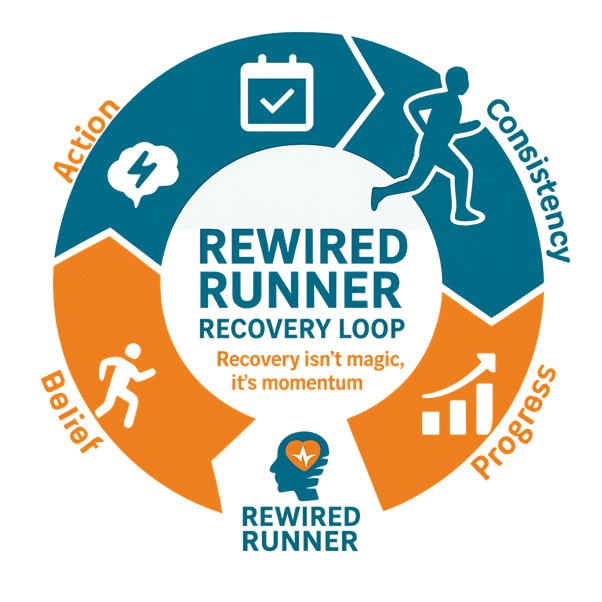
Section 3: The rewired runner recover loop
This loop isn’t theory; it’s how recovery actually happens in real life:
Action → Consistency → Progress → Belief → (back to Action)
At first, you don’t believe. You’re scared. You doubt everything, including yourself. But recovery doesn’t demand belief to begin; it demands action. If you do something today, you’re more likely to do it tomorrow. If you repeat it, your brain adapts. If your brain adapts, you make progress. Progress builds belief. And once belief arrives, motivation finally shows up, built on evidence, not emotion.
That is the opposite of what most people think. They wait for motivation. They wait to feel ready. But readiness is a lie. Nobody feels ready. You start anyway.
Section 4: Adaptation is the engine of recovery
The brain and body adapt to what you repeat. This isn’t opinion, it’s neuroscience.
When you stimulate neural pathways repeatedly, they strengthen through a process called long-term potentiation (LTP). When you repeat movement, speech, balance, or memory tasks, you trigger synaptic plasticity, and connections become more efficient. Over time, new neural pathways compensate for damaged ones.
That is what saved me.
Five minutes of walking used to destroy me. Then it didn’t. Then, 10 minutes was possible. Then 20. Then hills. Then running. Then mountains. The same process applied to speech clarity, breath control, left-side awareness, and mental stamina.
You cannot hack adaptation, but you can build it. Slowly. Patiently. Relentlessly.
This isn’t only for people who can run. If you’re in a wheelchair, neuroplasticity is still available to you. If one side is paralysed, adaptation is still available to you. If you’re 70 years old, adaptation is still available to you. It doesn’t matter where you start. It cares what you repeat.
Section 5: The truth about motivation
People think I’m naturally motivated. I’m not. I built motivation by doing things on days I didn’t want to. Consistency is not a personality trait; it’s a skill. Once you understand that, you stop waiting for motivation and start creating it.
Momentum comes from movement first. Confidence comes from seeing progress. Belief comes from proof. And hope, real hope, not the fake stuff, comes from experience.
Recovery doesn’t reward intensity. It rewards consistency. You don’t have to be perfect. You don’t have to move fast. You just have to keep moving forward.
Your recovery will take longer than you want. It will be harder than you expected. It will test you in ways you didn’t choose. But if you stay in the fight long enough, you will change. You will adapt. You will rise. And you will discover strength inside you that you didn’t know existed.
You are not done.
Section 6: The recovery loop
Section 7: Final Message
Recovery isn’t luck. It isn’t magic. It isn’t mindset alone. It is a system powered by patient action, consistency, and adaptation over time. Whether your goal is to speak clearly to your grandchildren again, climb stairs without fear, walk unaided, return to work, or reclaim your independence, the same loop applies.
Action → Consistency → Progress → Belief
Start where you are. Use what you have. Do what you can. Then repeat it tomorrow. Your future self is built one small decision at a time.
Support Us:
If you found value here, consider clicking the (Support Us button on the website), which is linked to “Buy Me a Coffee”, to make a small donation. This donation will help us to continue creating practical recovery resources.
References: (simplified, policy-aligned)
LTP and neural pathway strengthening – Journal of Neuroscience, 2019
Neuroplasticity and stroke recovery – Stroke Rehabilitation Journal, 2021
Dopamine and habit reinforcement – Nature Reviews Neuroscience, 2018
Fatigue and energy demand in neurorehabilitation – Frontiers in Neurology, 2020
Additional Disclaimer:
Medical Disclaimer
The content on this channel is for informational and motivational purposes only and should not be considered medical, therapeutic, or professional advice. I am not a licensed healthcare provider. Always consult your physician or a qualified health professional before starting or modifying any rehabilitation program, exercise routine, medication, or lifestyle change.
Personal Experience
Everything shared here stories, drills, opinions, and training methods comes from my personal stroke-recovery journey and individual learnings. Your situation, risks, and capabilities may differ.
Organisational Independence
I currently serve as an independent director and/or volunteer with several organisations (including St George’s Hospital and the Stroke Foundation).
All views expressed on this channel are strictly my own and do not represent, endorse, or reflect the positions of any organisation I am affiliated with.
No Liability
While I strive to present accurate, up-to-date information, I make no warranties or guarantees, express or implied about the completeness, reliability, or applicability of the content. Your use of any information provided is strictly at your own risk. I accept no responsibility for injury, loss, or damage that may result.
Affiliate & Sponsorship Note
From time to time, this channel may mention or link to products or services. If an affiliate link is used, I may earn a small commission at no extra cost to you. I only mention resources I genuinely believe can help the recovery community.
Emergency Disclaimer
If you think you are experiencing a medical emergency, call your local emergency number immediately. Do not rely on videos or online content for urgent medical care.